
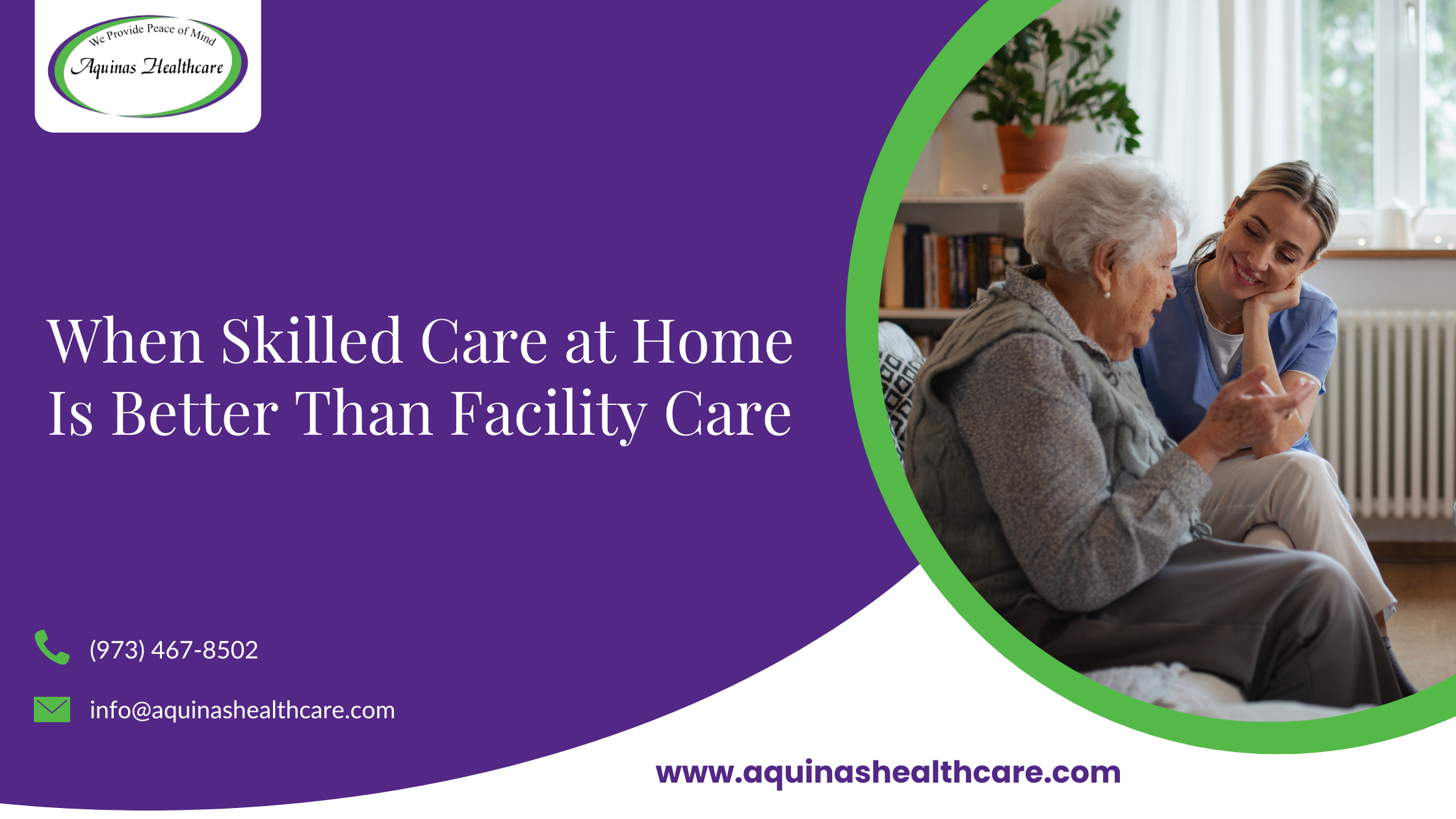
| Quick answer: For many patients, skilled care at home offers medical-grade support, familiar surroundings, and a smoother recovery compared to a nursing facility or rehab center. If your loved one needs nursing, therapy, or daily health monitoring after a hospital stay, trained professionals can deliver that care right in your home. The right choice depends on medical complexity, safety at home, and family support. This post walks you through the key differences so you can make an informed decision. |
When a doctor mentions post-acute care, many families picture a nursing facility or rehab center as the only option. That is not the case. Skilled care at home has grown significantly as a safe, effective alternative for patients recovering from surgery, managing chronic conditions, or needing ongoing clinical support. For the right candidate, home-based skilled care can match, and sometimes exceed, the quality of institutional care.
We understand that choosing between a facility and home care is one of the hardest decisions a family can face. The stakes feel high, the medical language is confusing, and everyone has an opinion. This post lays out the real differences, the practical factors, and what to ask so you can go into that conversation with your doctor feeling confident rather than overwhelmed.
What Skilled Care Actually Means
Skilled care refers to services that must be performed, or supervised, by a licensed professional. That includes registered nurses, licensed practical nurses, and licensed therapists. It is not just help with bathing or meals. It covers medication management, health monitoring, disease management, and clinical assessment. These are clinical tasks, not just supportive ones.
Many people assume skilled care can only happen in a facility with equipment and staff on every floor. In practice, the majority of skilled nursing and therapy services can travel to your front door. A nurse can assess a healing incision, manage medications, draw blood for labs, and adjust a care plan based on what she observes, all inside your home. The skill travels with the clinician.
- Medication administration and reconciliation
- Vital sign tracking and chronic disease monitoring
- Clinical assessment and condition management
- Therapy services delivered in the home setting
- Patient and family education on condition management
- Coordination with the attending physician
Six Situations Where Skilled Care at Home Is the Stronger Choice
Not every patient is a candidate for home-based skilled care, but more are than most families realize. If the home environment is safe, a responsible adult is available part of the time, and the medical condition does not require round-the-clock emergency equipment, home care is often the right call. Patients recovering in familiar environments often experience lower rates of hospital readmission and faster functional gains.
Below are the most common situations where home care outperforms a facility setting. If your loved one fits one or more of these descriptions, it is worth asking the discharge planner or physician specifically about home health as the primary post-acute option.
- Post-surgical recovery where mobility is limited but vitals are stable
- Chronic condition management such as heart failure, diabetes, or COPD
- Recovery requiring ongoing nursing assessment and therapy support
- Patients managing complex medication schedules that need professional oversight
- Patients with dementia who become distressed in unfamiliar settings
- Patients who declined rapidly after a previous facility stay
The Real Risks of a Facility Stay That No One Mentions
Nursing facilities and rehab centers serve an essential purpose, and many provide excellent care. But the risks of institutional settings are real and are often left out of the discharge conversation. Infection exposure is higher in any congregate setting. Deconditioning, meaning the loss of muscle strength and endurance from limited movement, can happen quickly in patients who are not mobilized consistently. Disorientation, especially in older adults, is common when routines and environments change abruptly.
For patients with memory conditions, a facility stay can accelerate confusion and distress in ways that are genuinely hard to reverse. A person with Alzheimer’s who knows where the bathroom is, recognizes the furniture, and hears familiar sounds has a cognitive anchor that a facility room cannot provide. These are not small quality-of-life details. They are clinically relevant factors that affect real outcomes.
How Aquinas Healthcare Delivers Skilled Care at Home in Summit, NJ
Aquinas Healthcare, Inc. provides nurse visits at home, home health aide services, therapy services, and specialized support for dementia and Alzheimer’s care across Summit, Chatham, and surrounding communities in New Jersey. Our clinicians coordinate directly with your physician to carry out the care plan, track progress, and communicate any changes in condition before they become emergencies. You can reach our team at (973) 467-8502 to discuss your specific situation.
We also support family caregivers. Respite care gives primary caregivers scheduled time away while a qualified professional maintains continuity of care at home. Homemaking services keep the home environment clean and organized, which matters for both patient safety and daily comfort. Our team works alongside you to build a plan that fits the actual needs of your household.
How to Have the Conversation With the Discharge Team
Hospital discharge planners move quickly. They often have a default recommendation ready before the family has processed what is happening. You have the right to ask questions and to request a home health evaluation before accepting a facility placement. Specifically, ask: Is my family member medically stable enough for home? What skilled services would be needed? Does insurance cover home health in this case? A good discharge planner will welcome those questions.
If your loved one is already in a facility and you want to explore transitioning home, that conversation is also possible. Contact us or call (973) 467-8502 and we can help you understand what a home care plan would look like, what clinical staffing would be needed, and how to present that option to the treating team. You do not have to navigate this alone.
- Ask the discharge planner: what skilled services are needed daily versus weekly?
- Request a home safety evaluation if mobility or fall risk is a concern
- Confirm insurance coverage for home health visits before agreeing to a facility
- Ask whether nursing and therapy services can be provided at home
- Identify a family contact who can be present for the first home visit
- Ask for the care plan details in writing so you can review them clearly
Frequently Asked Questions
Is skilled care at home covered by Medicare or insurance?
Medicare Part A and Part B cover home health services when a physician certifies that the patient is homebound and requires skilled nursing or therapy. Many private insurance plans also cover home health. This is general information, not advice; confirm the specifics of your plan with your insurer or care coordinator.
What is the difference between a home health aide and a skilled nurse?
A home health aide assists with personal care tasks such as bathing, dressing, and mobility. A skilled nurse performs clinical tasks such as medication management, health assessment, and condition monitoring. Both can work together as part of a coordinated home care plan.
How quickly can home care services start after a hospital discharge?
In most cases, services can begin within 24 to 48 hours of a referral. The discharge team or your family can contact a home health agency directly to initiate the process before the patient leaves the hospital.
What if the patient’s condition changes at home?
Skilled nurses conducting home visits are trained to assess for changes in condition and to communicate findings to the supervising physician promptly. Early detection at home often prevents a return trip to the emergency room.
Does Aquinas Healthcare serve areas outside Summit and Chatham?
Yes. Aquinas Healthcare, Inc. serves a wide area across northern and central New Jersey, including Madison, Florham Park, Millburn, Livingston, and many surrounding communities. Call (973) 467-8502 to confirm coverage for your specific address.